

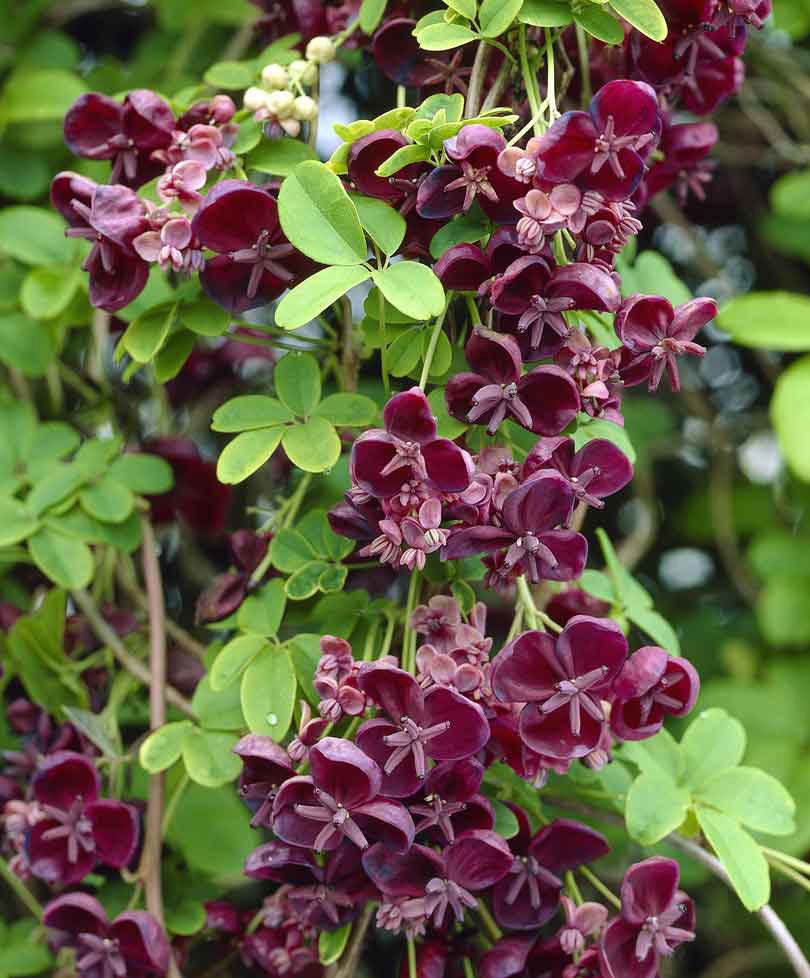
Chocolate vine (Akebia quinata) - live plant
Chocolate vine (Akebia quinata) - live plant
Live Akebia quinata plant, the chocolate vine. A hardy, vigorous climber whose purple flowers give off a scent in spring that is distinctly reminiscent of chocolate and vanilla.
Couldn't load pickup availability
Expédié depuis le Jura - Paiement sécurisé - Retrait possible à Francheville
What you receive
What you receive
- A live, rooted plant
- Hardy ornamental climber
- Packaging suited to live plants
Botanical description
Botanical description
Akebia quinata belongs to the Lardizabalaceae, a small East Asian family. Its epithet quinata refers to its leaves, made up of five leaflets arranged in a fan at the end of a long stalk.
Flowering, in April or May, is discreet to the eye but not to the nose. The flowers come in two kinds on the same plant: large purplish-brown female flowers and small, paler male ones, grouped in hanging clusters.
The foliage is semi-evergreen: it holds on for much of the winter in mild regions, which is valuable on a pergola or a fence you want to hide.
Growing
Growing
It is an easy and very hardy plant. Ordinary soil, sun or partial shade, a sturdy support and room to grow: it is vigorous and can cover several metres in a few seasons.
Prune without hesitation after flowering to keep it in check. In a garden where it is left to its own devices, it can become invasive: it is a vine that takes whatever it is given.
Frequently asked questions
Frequently asked questions
Does it really smell of chocolate?
Yes, that is its most widespread nickname. The chocolatey, vanilla scent is best noticed in mild weather and right up close to the flowers.
Does it produce fruit?
Rarely in France. Fruiting generally requires two genetically different plants to ensure cross-pollination, and a sufficiently warm summer.
Is it hardy?
Yes, very much so. It gets through the winters of almost the whole country without protection.
Does it lose its leaves?
Only partly. It is semi-evergreen: in a mild climate, it keeps a good share of its foliage all winter.
Also worth exploring: our rare plants and our aromatic plants.
