

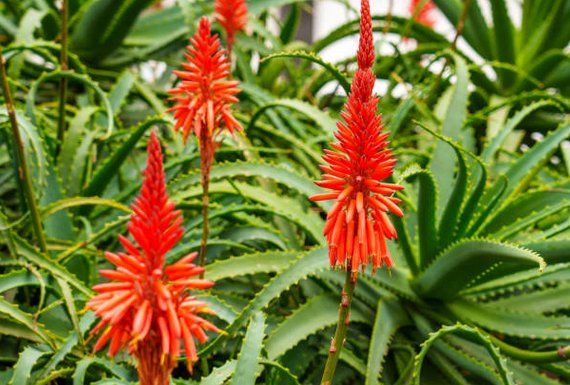
Aloe arborescens - live plant
Aloe arborescens - live plant
Live Aloe arborescens plant, a succulent native to southern Africa. One of the few garden plants to flower in the depths of winter, with orange-red spikes held upright above the rosettes.
Couldn't load pickup availability
Expédié depuis le Jura - Paiement sécurisé - Retrait possible à Francheville
What you receive
What you receive
- A live, rooted plant
- Sold as an ornamental and botanical collector's plant
- Packaging suited to live plants
Botanical description
Botanical description
Aloe arborescens belongs to the Asphodelaceae. Unlike aloe vera, which stays as a low rosette, this one develops stems and eventually forms a branched shrub, hence its epithet arborescens. In its natural habitat, it reaches two to three metres and forms impenetrable thickets on rocky slopes.
Its leaves are long, curved into a channel and edged with soft teeth. Flowering, in December and January, produces large conical clusters of bright orange-red, much visited by birds in its native range.
Growing
Growing
A very free-draining substrate, such as a cactus and succulent mix. Full sun, gradually acclimatising a plant that arrives from a greenhouse.
Water generously, then let it dry out completely between waterings. In winter, keep it almost dry: this is the period when it is most at risk of rotting. It tolerates short, light frosts if it is dry, but in a damp climate it is better to overwinter it under cover.
It propagates from cuttings with disconcerting ease: a detached stem, left to dry for a few days and then planted, roots on its own.
Frequently asked questions
Frequently asked questions
What is the difference from aloe vera?
The habit. Aloe vera stays as a low, stemless rosette. Aloe arborescens branches out and forms a shrub. Their flowering also differs, in colour as well as in season.
When does it flower?
In the depths of winter, often in December or January. This is its main ornamental asset, at a time of year when almost nothing is in bloom.
Is it frost-hardy?
A few degrees below zero, briefly and when dry. Winter damp is more dangerous to it than cold.
How do I propagate it?
By stem cuttings. Cut a stem, let the wound dry in the air for a few days, then plant in a dry substrate and wait before watering.
This plant is sold as an ornamental and botanical collector's plant. Also worth exploring: our rare plants.
