

Enchanter's nightshade (Circaea lutetiana) - seeds
Enchanter's nightshade (Circaea lutetiana) - seeds
Enchanter's nightshade (Circaea lutetiana): seeds of an unobtrusive perennial of Europe's cool, shady woodlands, known as witches' herb. Its genus name comes from Circe, the sorceress of the Odyssey who turned men into swine, and its epithet lutetiana means "of Lutetia", that is, of Paris.
Couldn't load pickup availability
Expédié depuis le Jura - Paiement sécurisé - Retrait possible à Francheville
What you receive
What you receive
A packet of Circaea lutetiana seeds, with a choice of 125, 250 or 500 seeds. They are small club-shaped fruits covered in hooked hairs.
A flower that counts in twos
A flower that counts in twos
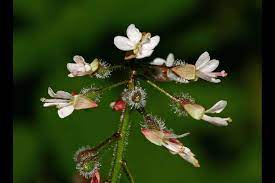
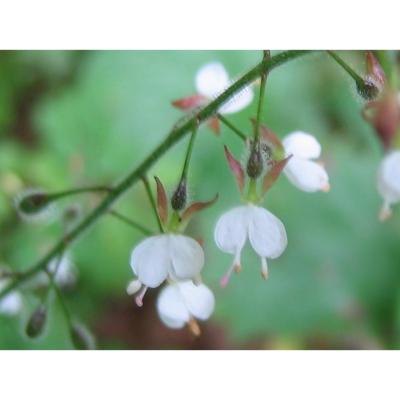
This is what makes it worth observing up close. In almost all flowering plants, the floral parts come in threes, fours or fives. Circaea does everything in twos: two sepals, two petals, two stamens, two chambers in the fruit. And each white petal is notched into two lobes, giving the illusion of four petals. This binary arrangement is a peculiarity of the Onagraceae of the genus Circaea.
Sowing
Sowing
The seed needs cold. Sow in autumn in a seed tray left outdoors, or stratify for six to eight weeks in the refrigerator in damp sand before a spring sowing. Sow barely covered, in a humus-rich substrate, and keep constantly moist, at 15 to 18 °C. Germination is slow and staggered.
Prick out 30 cm apart, in shade or partial shade, in cool, rich, humus-rich soil. It is a plant of hedge bottoms and woodland edges: full sun scorches it, and drought makes it disappear.
The mature plant
The mature plant
A slender upright stem 30 to 70 cm tall, with opposite oval leaves, long-pointed and finely toothed, topped by a loose cluster of small pinkish-white flowers from June to August. The whole effect is graphic and airy, at home in a shady corner where few things are willing to grow.
It is fully hardy and spreads by underground runners: established in soil that suits it, it gradually forms a carpet. That is an asset as shade ground cover, and a drawback in a border you want to keep tidy.
Fruits that cling
Fruits that cling
After flowering, the fruits become covered in hooked hairs that cling to animal fur and clothing: this is how it disperses, and it also explains why it is found along forest paths. Expect to bring some home on your sleeves if you brush past it in autumn.
Collector's seeds
Collector's seeds
These seeds are sold as ornamental and botanical collector's seeds. They are not a food product and are not intended to be consumed. We provide no dosage, no preparation method and no expected effect.
Frequently asked questions
Frequently asked questions
Why is it called witches' herb?
Because of its scientific name, inherited from Circe, and because of its habitat: dark undergrowth and woodland edges, classic territory for plant folklore. Nothing in the plant itself justifies the reputation, which is precisely what makes its name interesting.
Is it invasive?
It spreads by runners where it is happy. As shade ground cover that is desirable; in a mixed border it needs to be contained with buried edging.
Does it tolerate sun?
Poorly. It wants shade and coolness. In too bright a position, the foliage burns and the plant dwindles.
Is the flowering spectacular?
No, and you should know that before ordering. It is a plant of botanical interest and atmosphere, not a showy bedding plant.
Also worth exploring: our folklore plants and all our seeds from around the world.
