

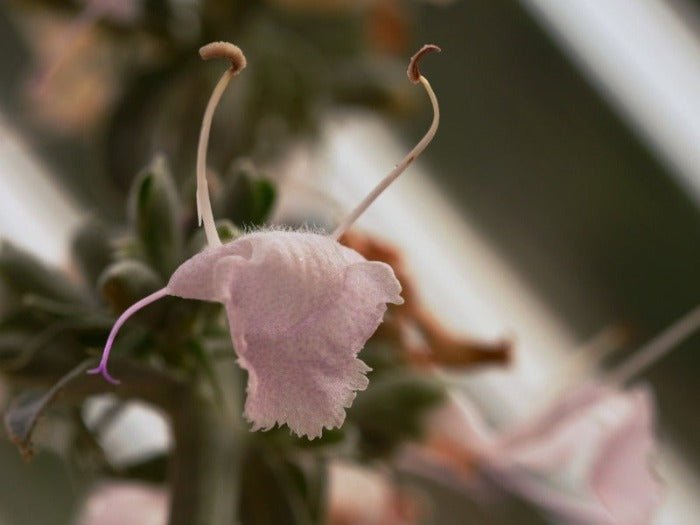
White sage (Salvia apiana) - live plant
White sage (Salvia apiana) - live plant
Live Salvia apiana plant, the white sage of California. Upright, silvery-white foliage with a resinous, balsamic scent very different from that of our culinary sages.
Couldn't load pickup availability
Expédié depuis le Jura - Paiement sécurisé - Retrait possible à Francheville
Grown, not wild-harvested
Grown, not wild-harvested
This is the point we want to be explicit about. Wild populations of Salvia apiana in California are under heavy harvesting pressure, and some of the white sage sold around the world comes directly from them.
Our plants are grown in our greenhouse in the Jura, without plant protection chemicals. Nothing is taken from the wild. Buying a live plant to grow, rather than harvested material, is by far the most low-impact way to take an interest in this species.
Botanical description
Botanical description
Salvia apiana is a shrubby member of the Lamiaceae from southern California and Baja California, where it grows in chaparral, the low, dry plant communities of California's Mediterranean climate.
Its thick leaves, covered in white down, form upright rosettes of a very pale grey, almost white in sunlight. The tall flower spikes carry white flowers washed with mauve. Its epithet apiana refers to bees, which visit it in great numbers.
Growing
Growing
Grow it as you would a garrigue plant, but it is even more demanding. It needs full sun and very free-draining, poor soil, and above all very little water. Winter wet is what kills it, never cold alone.
In open ground, keep it for regions with mild, dry winters, on a slope or in a rockery. Elsewhere, grow it in a pot in a mineral substrate and bring it in out of the rain in winter, to a bright, cool place.
Do not pinch it out too young: it first builds its rosette, then fills out.
A sacred plant for the peoples of California
A sacred plant for the peoples of California
Salvia apiana holds an important place in the cultures of several Indigenous peoples of southern California, notably the Chumash, Cahuilla and Kumeyaay, who use it in ceremonial contexts. We mention this because it is part of the plant's history, and out of respect for the communities concerned, several of which have publicly asked for its commercial harvesting to be limited.
Frequently asked questions
Frequently asked questions
How does it differ from common garden sage?
Both are Salvia, but everything else sets them apart: white sage is much more silvery, far more resinous in scent, and much less tolerant of damp.
Is it hardy in France?
Moderately, and only if kept dry. It can withstand a few degrees below zero if its base stays dry, but a wet winter is fatal to it even without hard frost.
Why are my leaves turning black?
Almost always because of too much water or a substrate that holds moisture. This plant prefers thirst to the opposite.
Does it attract pollinators?
Yes, a great many, hence its name apiana. Its flowers are very popular with bees.
This plant is sold as an ornamental and botanical collector's plant. Also worth exploring: our folklore plants and our natural incense.
