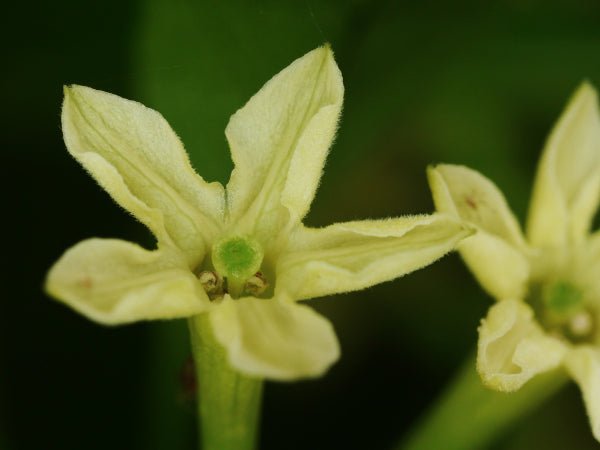

Pakalana (Telosma cordata) - live plant
Pakalana (Telosma cordata) - live plant
Pakalana (Telosma cordata): a twining vine from Southeast Asia, in the Apocynaceae family, whose small yellow-green flowers in umbels give off at nightfall a very intense, honeyed and fruity fragrance. Its Chinese name, 夜来香, literally means the fragrance that comes at night.
Couldn't load pickup availability
Expédié depuis le Jura - Paiement sécurisé - Retrait possible à Francheville
What you receive
What you receive
A young plant in a pot, to be repotted and trained on a support. The plant is sold in active growth and its size varies with the season.
Growing
Growing
This is a warm-climate plant and not hardy: it cannot tolerate frost and already suffers below 10 °C. In our climate, it is grown in a pot, outdoors in full sun from May to October, then under cover in winter, in a conservatory, a greenhouse or a bright, cool room.
- Compost: free-draining potting compost, with one third sand or pozzolana
- Position: full sun, which is what triggers flowering
- Watering: regular during growth, greatly reduced in winter
- Support: trellis, hoop or stake, it twines on its own
- Pruning: in spring, as it flowers on the current year's shoots
The mature plant
The mature plant
A supple vine of 2 to 4 m in a pot, with bright green heart-shaped foliage, that flowers in waves from summer to early autumn. The flowers are modest to look at and spectacular to smell: a single umbel fills an entire conservatory with fragrance in the evening.
What it is used for in Asia, and why not here
What it is used for in Asia, and why not here
In Vietnam and southern China, the flower buds and young leaves are a common vegetable, cooked in soup. This use, however, has no history of consumption in Europe: the plant therefore falls under the novel food regulations, and no authorisation exists to date. We sell it solely as an ornamental and botanical collector's plant, and we provide no recipe, no dosage and no expected effect.
Frequently asked questions
Frequently asked questions
Can it stay outdoors in winter?
No, except in a sheltered Mediterranean climate. A single night of frost is enough to kill it. Bring it in as soon as nights drop below 10 °C.
When does it give off its scent?
In the evening and for part of the night. During the day the fragrance is almost absent, which is typical of flowers pollinated by night-flying moths.
Should it be cut back?
Yes, in spring, and fairly short. It regrows vigorously and flowers on the current year's wood: a vine that is never pruned grows longer without flowering.
Is it a jasmine?
No, despite its trade names of Tonkin jasmine or night jasmine. True jasmines belong to the Oleaceae; pakalana is a member of the Apocynaceae, a cousin of the milkweeds.
Also worth exploring: akebia, a hardy vine with chocolate-coloured flowers, and our full range of rare plants and botanical curiosities.